Checking output before it leaves your hands
Claude's draft is a first draft. A two-minute check catches the one wrong number, date or name that would have cost you an afternoon.
You are the last line
Everything Claude writes for you goes out under your name. The customer does not know or care that an AI drafted it. If the quote is wrong, the date is wrong or the promise was never made, that is on you.
The good news: checking is fast once you know where the errors hide.
Where the errors hide
| Error type | What it looks like | How to catch it |
|---|---|---|
| Wrong specific | A date, price, quantity, name or address that is slightly off | Compare every number and name against the source, one by one |
| Invented detail | A policy, promise or fact that appears from nowhere (“as discussed, we offer a 30-day refund”) | Ask “where did this come from?” If it is not in the source, cut it |
| Missing item | The thread had four questions; the reply answers three | Count the asks in the original and tick them off |
| Wrong tone | Too formal, too casual, apologises for something that was not your fault | Read it aloud as if you were the recipient |
| Over-confidence | A guess stated as fact | Look for hedges that are missing. If Claude is sure about something you are not sure about, check it |
The two-minute check
Do this on every piece of output that goes to another person:
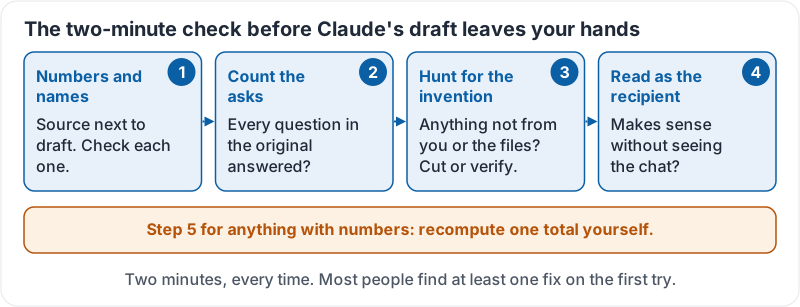
- Numbers and names. Put the source next to the draft. Check each one. This catches most real-world errors.
- Count the asks. How many things did the original message ask for? Are they all answered?
- Hunt for the invention. Is there any sentence that says something you did not tell Claude and that is not in the files? Cut or verify it.
- Read as the recipient. Would this make sense to someone who was not in the chat?
If the output is a table or spreadsheet summary, add a fifth step: recompute one total yourself. AI summaries of numbers are a common place for errors.
The check as a card you can keep next to your screen:
Ask Claude to help you check
Claude is good at checking its own work when you ask directly:
- “List every number and date in your draft and where each one came from in the thread.”
- “What did the customer ask for that your reply does not address?”
- “Which sentences in your draft are assumptions rather than facts from the source?”
This is not a substitute for your own check. It is a fast way to find the places to look.
A worked example
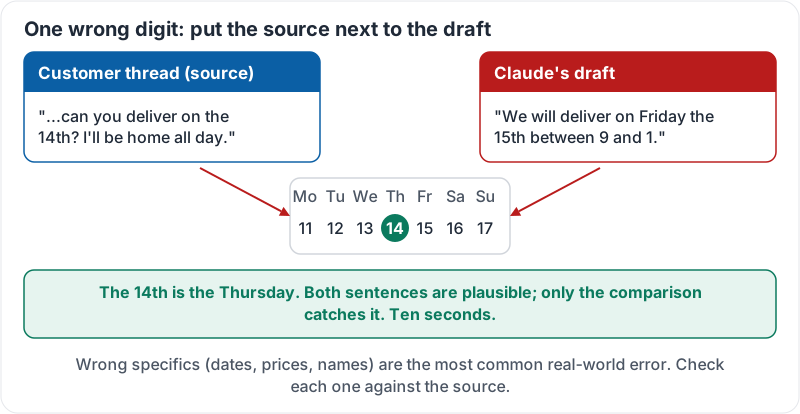
A customer thread mentions a delivery for “the 14th”. Claude’s draft says “we will deliver on Friday the 15th”. Both are plausible. The checker puts the thread next to the draft, spots the mismatch, looks at a calendar and sees the 14th is the Thursday. One wrong digit, caught in ten seconds, saves a missed delivery and an angry call.
The thread, the draft and the calendar side by side:
Try it now
Take any recent AI draft, from Claude or elsewhere, and run the two-minute check against its source. Count how many fixes you make. Most people find at least one on the first try.
Remember: numbers and names first, count the asks, hunt for the invention, read as the recipient. Two minutes, every time.
Checking your progress…